UI006
Interface walkthrough2 min read
Data quality: a to-do list, not a reproach
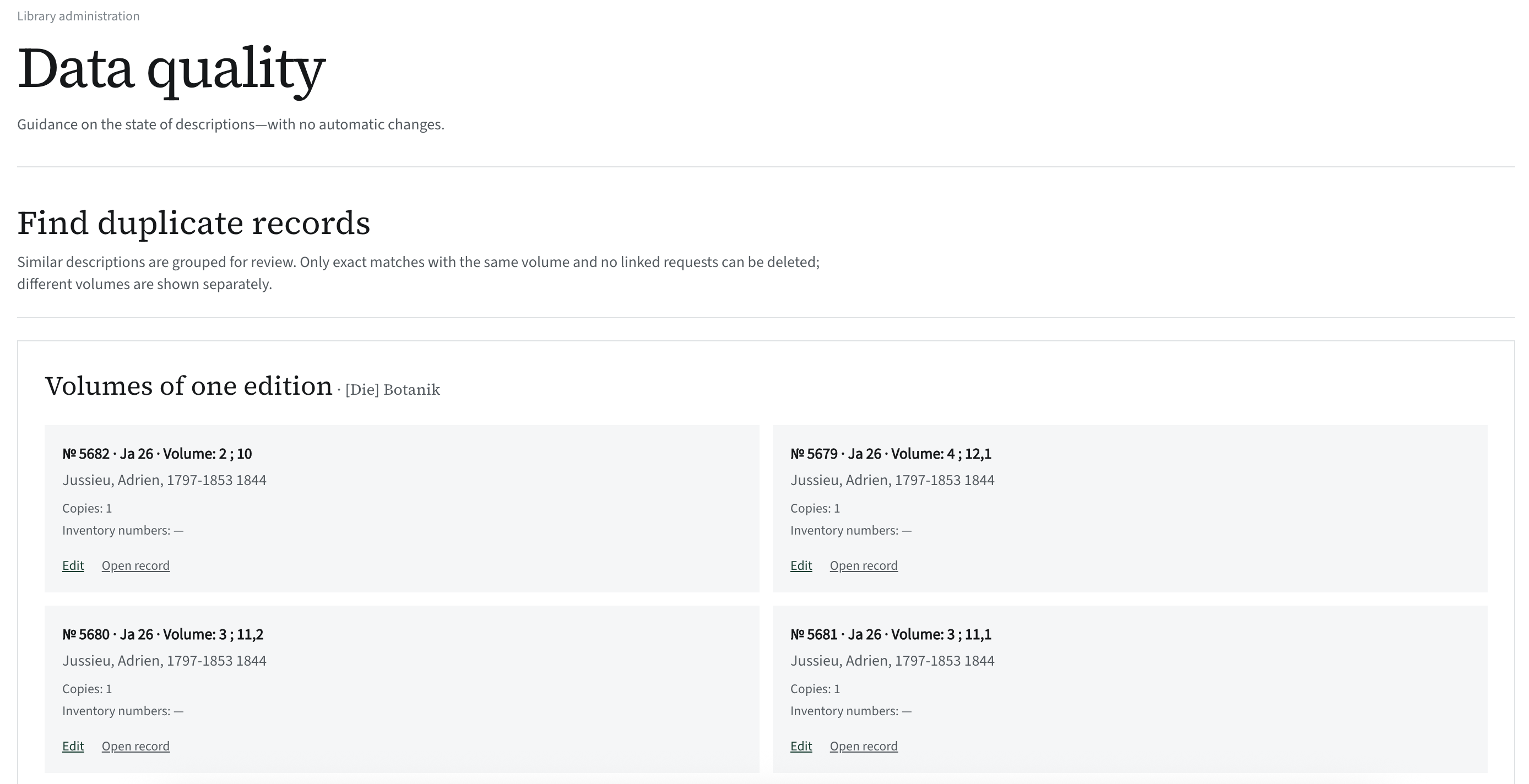
242 records without a year, 3,320 without a language, 121 duplicate ISBNs. In the old catalogue such things were found by chance. In Katlog they are gathered in one section, where each group is a clear task.
Any catalogue maintained over decades carries traces of different rules, different software and different people. That is normal. What isn’t normal is when those traces are invisible, get in readers’ way, and the librarian only finds out about them by chance.
The groups and why they matter
- No publication year (242) — the record doesn’t appear in the year filter.
- Non-standard year (56) — “19XX”, volume ranges, page counts instead of a year.
- No call number (109) — readers won’t find the book on the shelf.
- No title — the record is shown as “[untitled]”.
- No items — nothing to lend or request.
- No language (3,320) — the language filter doesn’t work.
- No subjects (1,423) — the record can’t be found through the “Subject” filter.
- Duplicate ISBN (121) — possible duplicates or volumes of one edition.
How to work with it
- Pick a groupClicking a card opens a list: call number, title, author and the problematic value itself.
- FixThe “Fix” button opens the record editor straight from the list.
- Or “Mark as checked”If it is meant to be that way — for example, two volumes sharing one ISBN. The mark applies only within that group: a record with no year but a correct ISBN stays in the “No year” group.
Fixed and checked records leave the list, and the counts are recalculated. Work that seemed endless becomes a queue that gets shorter.
From the development historyIn the first version written by the agent, this section showed only numbers. The groups couldn’t be opened; records could be neither fixed nor marked. On paper the section existed; in practice it didn’t. Places like this taught us to check not whether a feature exists but whether it can actually be used.