The call number as a spine label: why the catalogue starts at the shelf
For the librarian, the call number is a book’s address. For readers of the old catalogue, it was a line of small text in a table. We decided to show it the way it looks in the stacks.
The call number answers the reader’s most practical question: where is the book? In the MPT01 catalogue, call numbers look like this: F 759, I 200a, Ja 11. The letters denote a section of the classified shelving scheme; the number is the position within that section.
A label on the spine
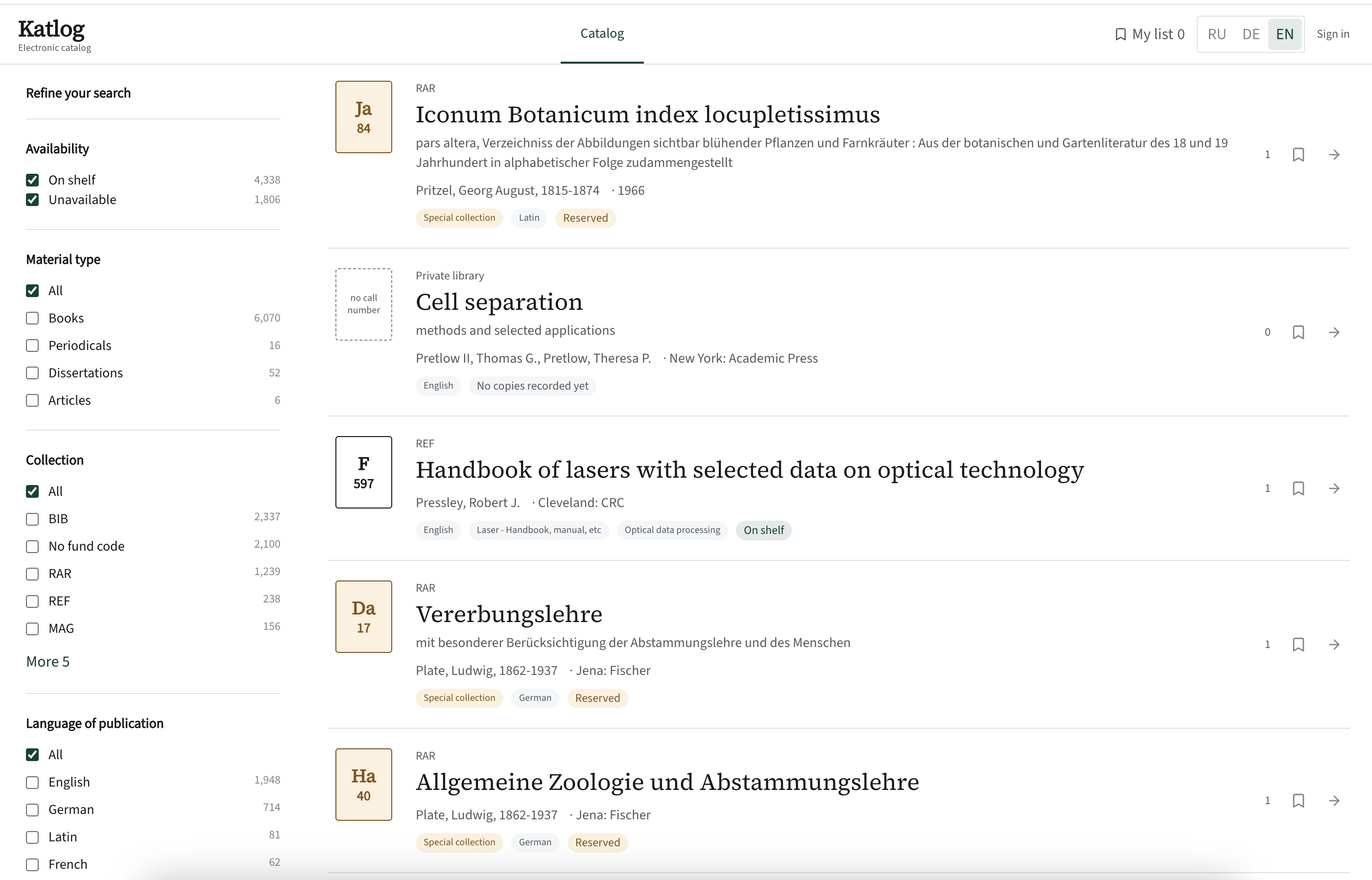
In the new catalogue, the call number in search results is styled like a label on a book spine: a white rectangle, the section in large type, the number below. Rare books get an amber label. If there is no call number, the frame is dashed and reads “no call number”.
Sorting the way the shelf does
Naive computer sorting puts F 1000 before F 200: it compares characters, not numbers. That never happens on a shelf. So the call number is split into parts: letters are compared as letters, numbers as numbers. The result is the order anyone who has shelved books would expect: I 200, I 200a, I 201.
Nearby on the shelf
Correct sorting gave us a feature the old catalogue never had. Every record page shows three neighbours to the left and three to the right — exactly the books standing next to it in the room. Classified shelving exists precisely so that related books stand together. Now that works on screen too.
And if there is no call number
Our export contains 117 records without a call number. For them, “Nearby on the shelf” is not shown, and the records themselves are collected under “Data quality”. A book without a call number is a book readers can’t find in the stacks — so it is one of the first groups to fix.