Why I started building a new catalogue
Our library’s Aleph catalogue was in place long before I started working here. It has served faithfully for years. But technology and readers’ expectations have moved on. This first, personal article is about that.
When I started working at the library of the Max-Planck-Haus in Tübingen, the online catalogue had long been in place. Colleagues before me built and filled it: judging by the dates in the item records, the library has kept electronic records since at least the early 2000s. I inherited it as a working system — with all its strengths and all the habits of earlier years.
What Aleph is
Aleph is one of the best-known library systems in the world. Its story began in 1980 at the Hebrew University of Jerusalem, which needed a system that could handle Hebrew and Latin scripts at the same time — and nothing on the market could. The name stands for Automated Library Expandable Program, and it is also the first letter of the Hebrew alphabet.
The system was later brought to the international market by Ex Libris. Aleph became a standard for university and national libraries, including in German-speaking countries: in 1997 Ex Libris acquired Dabis, a German library systems vendor. Aleph 500, a client-server system with a relational database, was introduced in 1996.
Today Ex Libris belongs to Clarivate, and its flagship product is Alma, a cloud platform introduced in 2012. Many major libraries are moving from Aleph to Alma, and Ex Libris itself publishes detailed guides for that migration.
What has changed
A catalogue designed decades ago meets the expectations of its time. Readers came to a computer in the library, knew the search rules and were prepared to learn the interface. Today’s readers search on their phones and expect instant suggestions, filters with counts and a clear record page — like any modern web service.
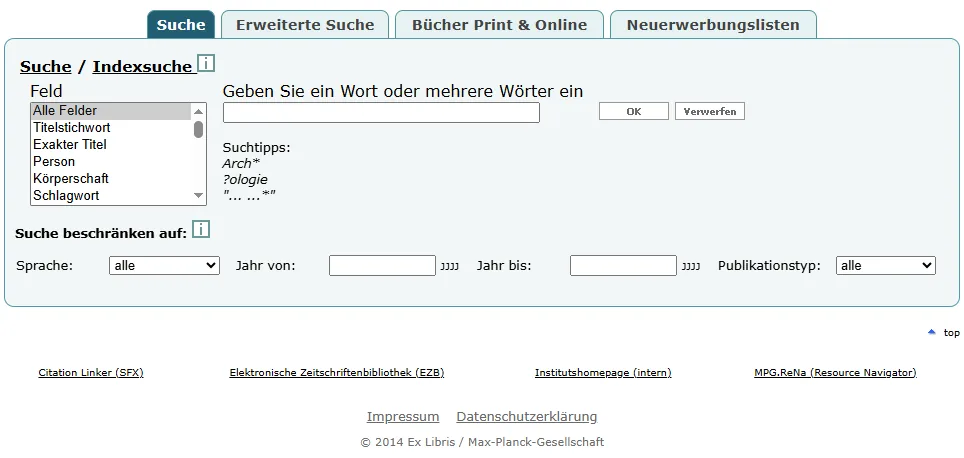
In my view, this shows most clearly in the Aleph OPAC:
- An interface from another era. Lots of system labels, small field tables, awkward on a phone.
- Search requires knowing the rules. To find everything you have to combine conditions; a simple wildcard does not work.
- Data locked inside the system. It is hard to present it any other way than the vendor intended, and almost impossible to check its quality quickly.
- Every change needs a specialist. For a small library without its own IT department, that means the system lives its own life and the librarian lives theirs.
What about Koha?
The obvious question: why build something new when open-source systems exist? The best known of them is Koha.
Koha was born in 1999 in New Zealand. The Horowhenua Library Trust needed to replace its old system before the year 2000, and instead of buying a commercial product it commissioned a new web-based system from Katipo Communications. The first installation went live in January 2000. The software was released as open source and named with a Māori word meaning “gift”. Koha is regarded as the world’s first open-source integrated library system.
An international community developed it further: multilingual support, MARC and Z39.50 followed, and dozens of companies worldwide offer installation and support. For a long time Koha was the example of what a modern, flexible, vendor-independent library system could be.
But in my view, what was a breakthrough twenty-five years ago feels different today. Koha is built on the classic technology stack of its time: Linux, a web server, a MySQL database and Perl. Installing and maintaining it still requires a server and someone who knows how to run it — or a paid contractor. For a small library without a programmer, that is a real barrier. The system is powerful, but heavy for anyone who simply needs a convenient catalogue and straightforward circulation.
Why an experiment
I wanted to test a different path. What if you start not by choosing a ready-made product, but with the data you already have? Take the open catalogue, look at the real records and ask: what could we build for readers with today’s tools — including artificial intelligence?
That is how Katlog came about: my private experiment using publicly available data. It does not replace the library’s official systems and does not claim to. It shows what a catalogue could look like if you built it today: fast search, honest filters, the call number as a spine label, a simple reader account and a librarian workspace where data problems become a clear to-do list.
- Ex Libris: company history — exlibrisgroup.com
- Ex Libris Group — Wikipedia
- Saffady W. Ex Libris Limited // Library Technology Reports, 1997 — history.exlibrisgroup.com
- Aleph to Alma Migration Guide — Ex Libris Knowledge Center
- Breeding M. The History and Background of Koha // Smart Libraries Newsletter, 2014 — librarytechnology.org
- Koha (software) — Wikipedia